
Modern vehicles are designed to provide smooth handling, better control, and safer driving experiences. One of the most important systems responsible for vehicle control is the steering system. Among all steering mechanisms used in automobiles, the rack and pinion steering system is the most common and widely used in modern cars, SUVs, and small trucks.
The rack and pinion system is popular because of its simple design, quick steering response, compact structure, and better driving comfort. It converts the rotational movement of the steering wheel into the linear motion required to turn the wheels of a vehicle.
Today, most passenger vehicles use rack and pinion steering because it offers better precision and easier handling compared to older steering systems.
In this article, you will learn:
- What rack and pinion steering is
- How it works
- Main components
- Steering ratio
- Power rack and pinion system
- Advantages and disadvantages
- Applications in modern vehicles
What Is Rack and Pinion Steering?
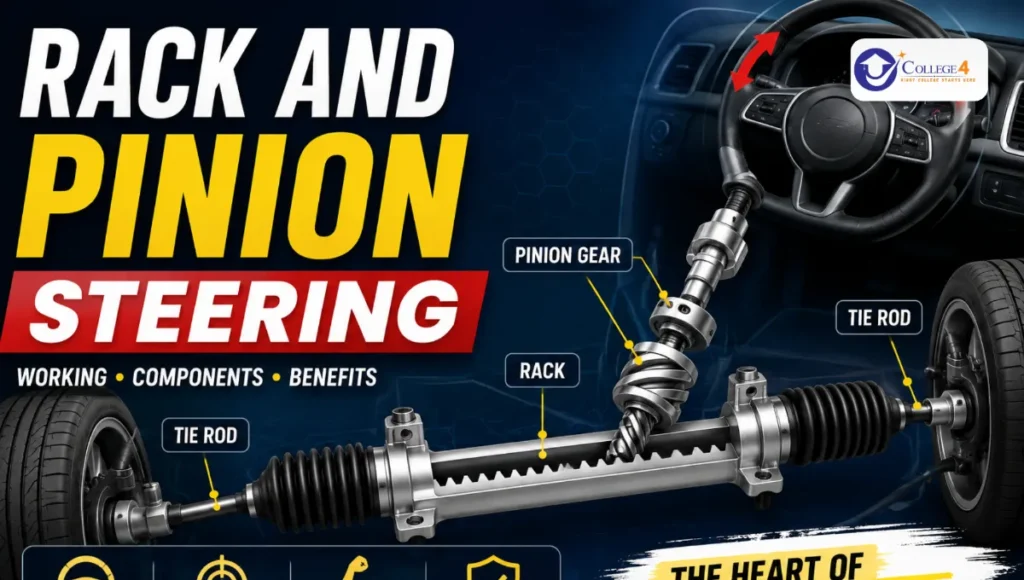
Rack and pinion steering is a steering mechanism used in vehicles to convert the circular movement of the steering wheel into the side-to-side motion needed to turn the wheels.
The system mainly consists of:
- A pinion gear
- A rack gear
- Tie rods
- Steering shaft
The rack and pinion gearset is enclosed inside a metal housing for protection and durability.
When the driver turns the steering wheel:
- The steering shaft rotates
- The pinion gear spins
- The rotating pinion moves the rack sideways
- The tie rods connected to the rack push or pull the wheels
- The wheels turn left or right
This mechanism provides accurate steering control and smoother vehicle handling.
Main Components of Rack and Pinion Steering
Understanding the major parts helps explain how the system works efficiently.
1. Steering Wheel
The steering wheel is the part controlled by the driver.
When the driver rotates the steering wheel, motion is transferred to the steering shaft.
2. Steering Shaft
The steering shaft connects the steering wheel to the pinion gear.
It transfers rotational force from the steering wheel into the steering mechanism.
3. Pinion Gear
The pinion is a small circular gear attached to the steering shaft.
As the steering wheel rotates, the pinion gear also rotates.
4. Rack Gear
The rack is a straight gear connected to the pinion.
The spinning pinion moves the rack left or right in a straight-line motion.
5. Tie Rods
Tie rods connect both ends of the rack to the steering arms attached to the wheels.
They transfer movement from the rack to the wheels.
How Does Rack and Pinion Steering Work?
The working principle of rack and pinion steering is simple and efficient.
Here is the step-by-step process:
Step 1: Driver Turns the Steering Wheel
The driver rotates the steering wheel either left or right.
Step 2: Steering Shaft Rotates
The steering shaft connected to the wheel transfers this motion to the pinion gear.
Step 3: Pinion Gear Spins
The pinion gear rotates along with the steering shaft.
Step 4: Rack Moves Sideways
The rotating pinion pushes the rack gear sideways.
- Turning left moves the rack in one direction
- Turning right moves it in the opposite direction
Step 5: Tie Rods Move the Wheels
The tie rods connected to the rack push or pull the steering arms.
This movement turns the vehicle’s front wheels.
Functions of Rack and Pinion Steering
The rack and pinion system performs two major functions.
1. Converts Rotational Motion into Linear Motion
The steering wheel rotates in circles, but vehicle wheels need side-to-side movement.
The rack and pinion system converts:
- Circular steering motion
into - Linear wheel movement
2. Provides Gear Reduction
The system reduces steering effort using gear ratios.
This allows drivers to turn wheels more easily, especially during low-speed driving or parking.
What Is Steering Ratio?
Steering ratio refers to how much the steering wheel must turn to rotate the vehicle wheels by a certain angle.
For example:
If:
- One full steering wheel rotation = 20° wheel movement
Then the steering ratio becomes:
360∘÷20∘=18:1
This means the steering wheel must rotate 18 degrees to move the wheels by 1 degree.
High vs Low Steering Ratio
Low Steering Ratio
- Faster steering response
- Less steering wheel movement needed
- Common in sports cars
High Steering Ratio
- Easier steering effort
- More wheel rotation needed
- Common in large vehicles and trucks
Sports cars often use lower steering ratios for quicker handling and better responsiveness.
Variable Ratio Steering
Some modern vehicles use variable-ratio rack and pinion steering systems.
In this system:
- The center part of the rack has different gear spacing
- Outer sections have different tooth pitch
This design offers:
- Quick response during small turns
- Reduced steering effort during sharp turns
Variable steering improves both comfort and handling performance.
Power Rack and Pinion Steering
Modern vehicles usually use power-assisted rack and pinion steering systems.
These systems reduce steering effort using hydraulic or electric assistance.
How Power Rack and Pinion Works
In power steering systems:
- A piston is connected to the rack
- Hydraulic fluid or electric motors provide assistance
- Pressure helps move the rack more easily
When the driver turns the steering wheel:
- Fluid pressure assists rack movement
- Steering becomes smoother and lighter
This is especially useful:
- During parking
- At low speeds
- In heavy vehicles
Advantages of Rack and Pinion Steering
Rack and pinion steering offers many benefits, which is why it is widely used in modern vehicles.
1. Simple Design
The system has fewer components compared to older steering mechanisms.
This makes it:
- Compact
- Lightweight
- Easier to maintain
2. Better Steering Response
Rack and pinion steering provides:
- Faster wheel response
- Improved vehicle control
- Better handling precision
Drivers feel more connected to the road.
3. Smooth Driving Experience
The system offers smooth and comfortable steering performance, especially with power steering assistance.
4. Reduced Weight
Its compact structure reduces vehicle weight, improving:
- Fuel efficiency
- Performance
- Handling
5. Low Maintenance
Rack and pinion systems are durable and generally require less maintenance compared to older steering systems.
Disadvantages of Rack and Pinion Steering
Although highly efficient, the system also has some limitations.
1. Expensive Repairs
If internal components fail, repairs or replacements can become costly.
2. Wear and Tear
Over time:
- Tie rods
- Rack seals
- Steering gears
may wear out and require servicing.
3. Fluid Leaks in Hydraulic Systems
Hydraulic power steering systems may develop fluid leakage problems.
Common Problems in Rack and Pinion Steering
Some common steering issues include:
- Steering wheel vibration
- Hard steering
- Fluid leakage
- Uneven steering response
- Noise while turning
- Loose steering feel
Regular maintenance helps prevent major steering problems.
Applications of Rack and Pinion Steering
Rack and pinion steering is commonly used in:
- Passenger cars
- SUVs
- Hatchbacks
- Sedans
- Small trucks
- Sports cars
Its compact size and efficient performance make it ideal for modern automobiles.
Why Modern Cars Prefer Rack and Pinion Steering
Automobile manufacturers prefer rack and pinion steering because it provides:
- Better accuracy
- Faster response
- Improved safety
- Lower weight
- Enhanced driving comfort
Its ability to combine efficiency, precision, and simplicity makes it the standard steering system in most modern vehicles today.
Conclusion
Rack and pinion steering is one of the most important innovations in modern automobile engineering. It converts the rotational movement of the steering wheel into linear motion that turns vehicle wheels smoothly and accurately.
The system consists of simple components such as the pinion gear, rack gear, steering shaft, and tie rods, all working together to provide precise steering control. Modern power-assisted rack and pinion systems further improve driving comfort by reducing steering effort.
Because of its compact design, quick response, low maintenance, and excellent handling performance, rack and pinion steering has become the preferred steering system for most cars, SUVs, and small trucks around the world.
Understanding how rack and pinion steering works helps drivers appreciate the technology that makes modern driving safer, smoother, and more efficient.