
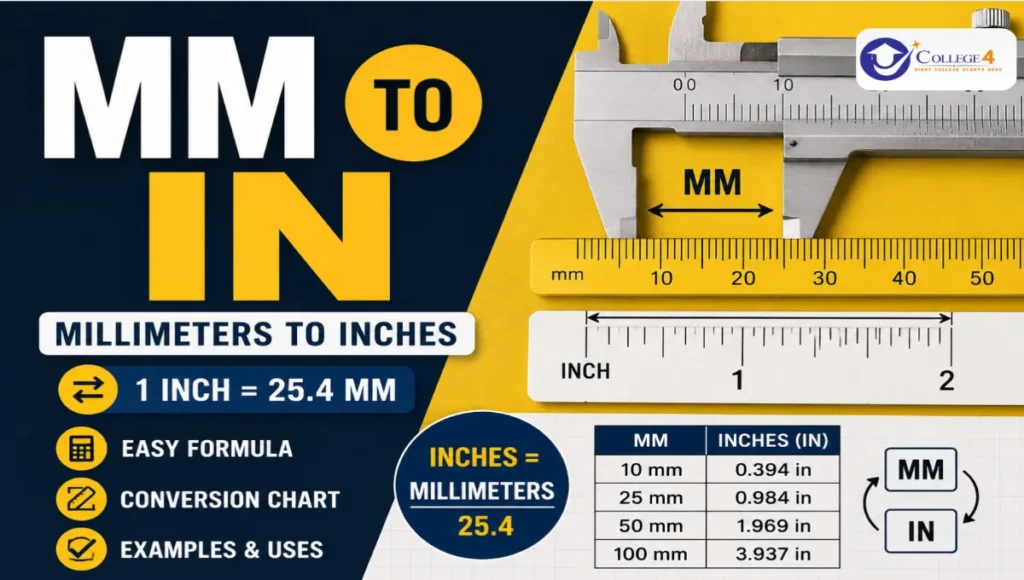
Measurements are an important part of daily life. Whether you are working on construction projects, buying furniture, designing machinery, measuring electronic devices, or handling property documents, accurate unit conversion is essential. One of the most commonly used conversions is mm to in, which means converting millimeters into inches.
Millimeters and inches belong to two different measurement systems. Millimeters are part of the metric system, while inches are used in the imperial and US customary systems. Since both systems are widely used around the world, people often need to switch between them for professional, technical, and personal work.
Understanding the correct conversion method helps avoid mistakes, improves precision, and ensures measurements remain consistent across projects and industries.
In this detailed guide, you will learn:
- What millimeters and inches are
- Why mm to in conversion matters
- The correct conversion formula
- Easy examples
- A quick conversion table
- Common mistakes to avoid
- Practical uses of mm-to-inch conversions
What Is a Millimeter (mm)?
A millimeter, written as mm, is a small unit of length in the metric system.
One millimeter equals:
- 1/1000 of a meter
- 0.1 centimeters
Millimeters are commonly used when accurate and detailed measurements are required. Because they are small units, they are ideal for measuring:
- Thickness of materials
- Electronic components
- Mechanical parts
- Medical instruments
- Construction details
- Engineering designs
For example:
- The thickness of a mobile phone may be measured in millimeters.
- Machine parts often use mm measurements for precision.
- Architectural plans frequently include dimensions in mm.
Millimeters are widely used in India and most countries that follow the metric system.
What Is an Inch (in)?
An inch, written as in or “, is a unit of length used in the imperial and US customary measurement systems.
One inch equals:
- 2.54 centimeters
- 25.4 millimeters
Inches are commonly used in:
- Television screen sizes
- Laptop displays
- Furniture dimensions
- Construction work in some countries
- Pipe and hardware sizes
- Clothing and tailoring
There are:
- 12 inches in one foot
- 36 inches in one yard
Although many countries now prefer the metric system, inches are still widely used globally, especially in the United States and in product specifications.
Why Is MM to IN Conversion Important?
Converting millimeters to inches is important because many industries use both measurement systems together.
For example:
- A machine designed in Europe may use mm measurements, while an American supplier uses inches.
- Furniture dimensions may be listed in inches, but room measurements are taken in millimeters.
- Construction materials and imported products often use different units.
Accurate conversion helps avoid:
- Design errors
- Wrong measurements
- Manufacturing issues
- Property documentation mistakes
- Installation problems
Even a small error in conversion can create serious issues in engineering, construction, and manufacturing projects.
MM to IN Conversion Formula
The conversion formula from millimeters to inches is very simple.
1 inch=25.4 mm
To convert millimeters into inches, use this formula:
Inches=25.4Millimeters
This means you divide the millimeter value by 25.4 to get the measurement in inches.
Example of MM to IN Conversion
Let’s understand the conversion with a simple example.
Suppose you want to convert 50 mm into inches.
Step 1: Take the millimeter value
50 mm
Step 2: Divide by 25.4
50÷25.4=1.9685
Final Answer:
50 mm = 1.97 inches (approximately)
MM to IN Conversion Table
Below is a quick reference table for commonly used mm-to-inch conversions.
| Millimeters (mm) | Inches (in) |
|---|---|
| 1 mm | 0.039 in |
| 5 mm | 0.197 in |
| 10 mm | 0.394 in |
| 20 mm | 0.787 in |
| 25 mm | 0.984 in |
| 30 mm | 1.181 in |
| 40 mm | 1.575 in |
| 50 mm | 1.969 in |
| 75 mm | 2.953 in |
| 100 mm | 3.937 in |
| 150 mm | 5.906 in |
| 200 mm | 7.874 in |
| 300 mm | 11.811 in |
This table is useful for quick calculations without needing a calculator every time.
Where Is MM to IN Conversion Used?
Millimeter-to-inch conversion is used in many industries and daily activities.
1. Construction and Architecture
Builders and architects often deal with both metric and imperial measurements. Accurate conversion ensures proper dimensions for:
- Doors
- Windows
- Pipes
- Tiles
- Furniture fittings
2. Engineering and Manufacturing
Machine parts and industrial components require precise measurements. A small conversion error can affect the entire production process.
Engineers regularly convert mm into inches while working with:
- Mechanical drawings
- Machine tools
- Automobile parts
- Industrial equipment
3. Electronics
Electronic devices like TVs, monitors, and smartphones are often marketed in inches, while internal components may use millimeters.
For example:
- Screen size = inches
- Device thickness = millimeters
4. Real Estate and Property Documentation
Property plans and technical drawings often use metric units. However, imported tools or construction references may use inches.
Accurate conversion helps in:
- Property valuation
- Loan documentation
- Building approvals
- Construction planning
5. DIY and Home Improvement
People working on home projects often need to convert measurements for:
- Furniture assembly
- Wall mounting
- Plumbing
- Interior design
- Woodworking
Understanding conversion makes installation easier and more accurate.
Common Mistakes to Avoid During Conversion
Even though the formula is simple, many people make avoidable mistakes.
1. Using the Wrong Formula
Some people multiply instead of dividing while converting mm to inches.
Correct formula:
- Divide mm by 25.4
2. Rounding Too Early
Rounding numbers too soon can reduce accuracy.
For technical work, keep at least:
- 2 decimal places
- Or more for engineering precision
3. Confusing CM and MM
Remember:
- 10 mm = 1 cm
- 25.4 mm = 1 inch
Mixing centimeters and millimeters can create large calculation errors.
4. Incorrect Calculator Inputs
Typing the wrong decimal or forgetting brackets can change results completely.
Always double-check your calculations.
Benefits of Using Online MM to IN Converters
Online conversion tools make calculations much faster and easier.
Advantages
- Instant results
- Accurate calculations
- Useful for technical measurements
- Easy for large values
- Helpful for fractional conversions
Disadvantages
- Requires internet access
- Some outdated websites may show incorrect approximations
Manual calculation is still important because it helps verify results independently.
Why Precision Matters in Measurement Conversion
Precision is extremely important in industries like:
- Construction
- Manufacturing
- Healthcare
- Engineering
- Architecture
Incorrect measurements can lead to:
- Material waste
- Installation issues
- Project delays
- Financial losses
- Safety problems
This is why professionals always rely on standard conversion values and accurate measuring tools.
Tips for Accurate MM to IN Conversion
Here are some simple tips for better accuracy:
- Always use the standard value: 25.4 mm = 1 inch
- Double-check calculations
- Use digital calculators for technical work
- Avoid unnecessary rounding
- Understand whether values are approximate or exact
- Keep conversion charts for quick reference
Conclusion
Understanding how to convert mm to in is essential in today’s world because both metric and imperial measurements are widely used across industries and countries.
The conversion process is simple:
Inches=25.4Millimeters
Whether you are working in construction, engineering, electronics, real estate, manufacturing, or home improvement, accurate measurement conversion helps avoid costly mistakes and improves efficiency.
By learning the correct formula, using quick conversion tables, and avoiding common mistakes, anyone can confidently convert millimeters into inches with precision and ease.