
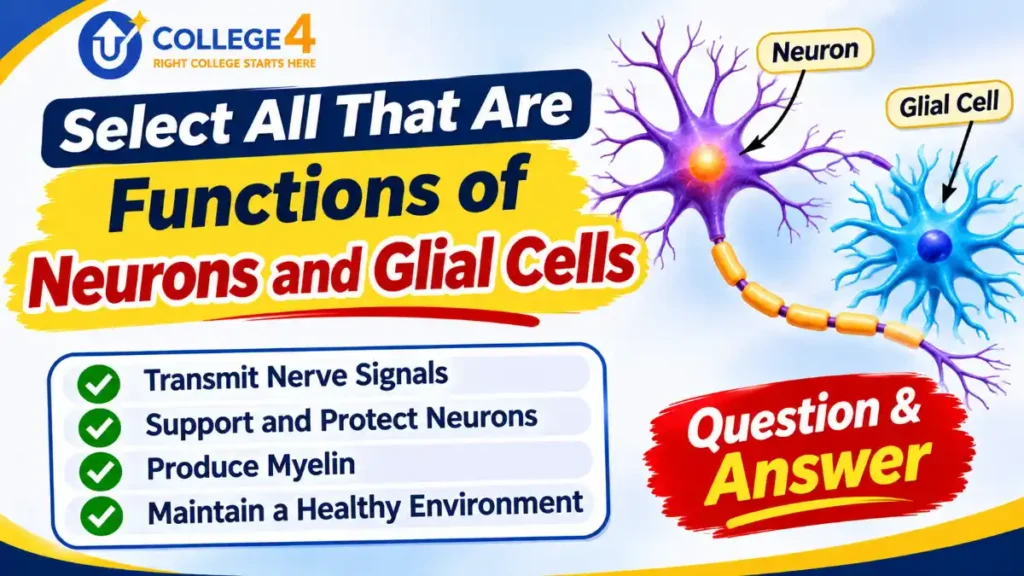
The nervous system controls and coordinates different activities of the human body. It receives information, processes signals, and sends messages to different body parts. Two important types of cells that make this possible are neurons and glial cells.
In this article, we will understand the functions of neurons and glial cells and identify the correct answers.
Question:
Select all that are functions of neurons and glial cells.
Choose all the correct options:
A. Receiving and transmitting nerve signals.
B. Supporting and protecting neurons.
C. Producing myelin around nerve fibres.
D. Helping maintain a healthy environment for nerve cells.
E. Pumping blood throughout the body.
Understanding Neurons and Glial Cells
The nervous system contains two major types of cells: neurons and glial cells. Both perform important functions, but their roles are different.
1. Neurons
Neurons are specialised nerve cells that receive, process, and transmit information throughout the body. They communicate with other neurons, muscles, and glands through electrical and chemical signals.
The main functions of neurons include:
- Receiving signals from other cells.
- Processing information.
- Transmitting nerve impulses to other cells.
- Helping control movement, thoughts, memory, and sensations.
2. Glial Cells
Glial cells, also known as neuroglia, are supporting cells of the nervous system. They help neurons work properly and maintain a healthy environment for nerve cells.
The main functions of glial cells include:
- Providing support and protection to neurons.
- Supplying nutrients to nerve cells.
- Producing myelin around certain nerve fibres.
- Maintaining the chemical balance around neurons.
- Helping protect the nervous system from infections and damage.
Correct Answer:
Options A, B, C, and D are correct.
Answer and Explanation:
Let’s understand why these options are correct or incorrect.
| Option | Explanation | Result |
|---|---|---|
| A. Receiving and transmitting nerve signals | Neurons receive and transmit information through nerve impulses. | Correct |
| B. Supporting and protecting neurons | Glial cells provide support and protection to neurons. | Correct |
| C. Producing myelin around nerve fibres | Certain glial cells produce myelin, which helps nerve signals travel faster. | Correct |
| D. Maintaining a healthy environment for nerve cells | Glial cells help maintain the proper environment for neurons. | Correct |
| E. Pumping blood throughout the body | Pumping blood is the function of the heart, not neurons or glial cells. | Incorrect |
Therefore, the correct choices are A, B, C, and D.
Final Answer:
Neurons receive, process, and transmit nerve signals, while glial cells support, protect, and nourish neurons. They also help produce myelin and maintain a healthy environment for nerve cells.
Thus, Options A, B, C, and D are the correct answers.