
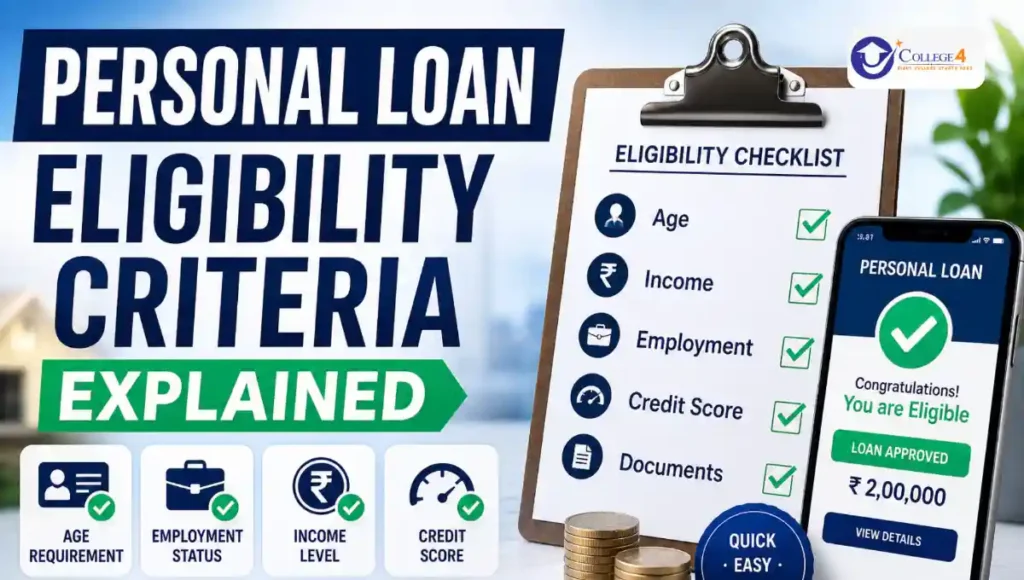
Applying for a Personal Loan today feels quick.
Open a loan app, fill in a few details, upload documents, and sometimes, within minutes, you see an approval. It almost feels effortless.
But behind that speed, there is still a system working in the background.
Lenders are checking. Assessing. Deciding.
And if you don’t understand what they are looking for, approvals can become unpredictable.
The better approach is simple: know how they evaluate you before you apply.
Why Eligibility Still Matters, Even With Fast Apps?
It’s easy to assume that a Personal Loan App removes all complexity.
It doesn’t.
It only makes the process faster.
The decision itself still depends on a few core questions:
Can you repay the loan?
Is your income stable?
How risky do you appear as a borrower?
Everything else builds on that.
If your profile answers these well, approvals become smoother. If not, even the fastest app won’t help much.
The Basics, Age and Eligibility
Let’s start with the obvious.
Most lenders expect you to fall within a certain age range. Usually between 21 and 60, sometimes slightly higher for self-employed individuals.
You also need to be an Indian resident with valid identity and address proof.
Nothing complicated here.
But these are the minimum filters. Not the deciding ones.
Income, Where Most Decisions Begin
If there’s one thing lenders focus on, it’s income.
Not just how much you earn. But how consistently you earn it.
For salaried individuals, this appears as salary credits. For self-employed borrowers, it comes down to business income and cash flow.
Higher income helps, but stability matters more.
A steady ₹40,000 per month often looks better than irregular, higher earnings.
For lenders, predictability reduces risk.
Job or Business Stability, Quietly Important
This is one factor people underestimate.
Frequent job changes, long gaps, or inconsistent business income can raise questions.
Lenders usually prefer:
- At least 6–12 months with your current employer
- A few years of business continuity for self-employed individuals
It signals reliability.
Not something you can fix overnight, but something that builds over time.
Credit Score, Still a Key Indicator
Your credit score is basically your financial track record.
It tells lenders how you’ve handled credit in the past.
A score above 750 is usually considered strong.
But even if you’re slightly below that, it doesn’t automatically mean rejection. Many digital platforms now look beyond just the number.
Still, the basics remain:
- Pay EMIs on time
- Avoid defaults
- Keep credit utilisation under control
These small habits matter more than most people realise.
Existing EMIs: How Much Is Too Much?
This is where your current financial load comes in.
Lenders look at how much of your income is already committed to EMIs.
If too much is already going out, adding another Personal Loan becomes risky for them.
This is called your debt-to-income ratio.
Lower is better.
If possible, reducing existing obligations before applying can improve your chances.
Your Bank Statement Tells a Story
This part is often overlooked.
Your bank statement is more than just numbers. It reflects your habits.
Lenders look for patterns:
- Is your balance stable?
- Are there frequent overdrafts?
- Any cheque bounces?
- Irregular large withdrawals?
Even without saying anything, your transactions tell them how you manage money.
Clean, consistent banking behaviour builds trust.
Location and Employer, Subtle Factors
Some lenders consider where you live and where you work.
Applicants from larger cities or reputed companies are sometimes seen as lower risk.
But this is changing.
Digital lending has expanded access. A good profile can get approved regardless of location.
Still, these factors can influence speed and terms.
Documentation, Simple but Important
Even with a Loan App, you can’t skip documentation.
You’ll typically need:
- Identity proof
- Address proof
- Income proof
- Bank statements
The key is consistency.
If your documents don’t match or show gaps, it slows things down or leads to rejection.
How Digital Lending Has Changed Things?
This is where things have evolved.
Earlier, decisions were based mostly on credit scores and income.
Now, a Personal Loan App looks at more.
Transaction patterns. Spending behaviour. Income flows.
Some platforms even analyse digital behaviour to assess risk.
It makes credit more accessible, especially for people with limited credit history.
But it doesn’t remove the need for a strong financial profile.
Small Things That Improve Your Chances
Before applying, a few adjustments can help.
- Keep your income stable
- Pay all dues on time
- Reduce existing EMIs if possible
- Maintain a clean bank statement
- Avoid applying to multiple apps at once
These aren’t complicated steps.
But they make a noticeable difference.
Conclusion
Getting a Personal Loan today is easier than it used to be.
A Loan App or Personal Loan App can take you from application to approval in minutes.
But the fundamentals haven’t changed.
Lenders still look at income, stability, credit behaviour, and financial discipline.
Understanding this puts you in a better position.
Because once you know what matters, you can prepare for it.
And when your profile is strong, approvals stop feeling uncertain.
They become expected.