
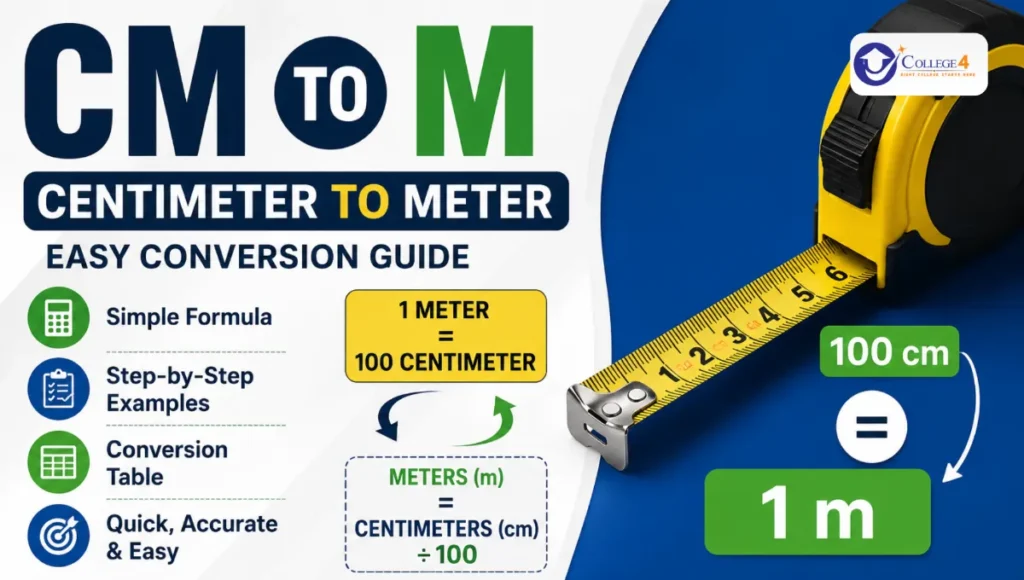
Measurement conversion is an important part of daily life, education, engineering, construction, science, and many professional industries. Among the most commonly used metric conversions is cm to m, which means converting centimeters into meters.
Both centimeters and meters belong to the metric system, one of the most widely used measurement systems in the world. While centimeters are useful for measuring smaller objects and shorter distances, meters are preferred for larger dimensions and standardized calculations.
Understanding how to convert cm to m correctly helps improve accuracy, reduce confusion, and make measurements easier to understand. Whether you are solving mathematics problems, measuring furniture, working on construction projects, or handling technical documents, knowing the correct conversion process is extremely useful.
This detailed guide explains:
- What centimeters and meters are
- The cm-to-m conversion formula
- Step-by-step conversion methods
- Practical examples
- Conversion tables
- Common uses of centimeter-to-meter conversion
- Mistakes to avoid during calculations
What Is a Centimeter (cm)?
A centimeter, written as cm, is a unit of length in the metric system.
One centimeter equals:
- 1/100 of a meter
- 10 millimeters
Centimeters are commonly used for measuring smaller objects because they provide a balance between precision and simplicity.
For example, centimeters are often used to measure:
- Human height
- Books and notebooks
- Clothing dimensions
- Household items
- School projects
- Interior decoration items
Because centimeters are smaller than meters, they allow more detailed measurements without needing long decimal numbers.
Centimeters are widely used in:
- Schools and education
- Tailoring and fashion
- Healthcare
- Interior design
- Product packaging
- Daily household measurements
What Is a Meter (m)?
A meter, written as m, is the base unit of length in the International System of Units (SI).
Meters are used globally for measuring:
- Distance
- Height
- Room dimensions
- Land measurements
- Building sizes
- Scientific calculations
Compared to centimeters, meters are better suited for larger measurements because they simplify large values and make calculations easier to understand.
For example:
- A room may be measured in meters instead of centimeters.
- Road distances are expressed in meters or kilometers.
- Construction plans often use meter-based measurements.
The meter is one of the most important units in science, engineering, and construction because it provides a standardized system used worldwide.
Relationship Between Centimeters and Meters
Centimeters and meters are directly connected within the metric system.
1 meter=100 centimeters
This means:
- 100 centimeters make 1 meter
- 1 centimeter equals 0.01 meter
Because the relationship is simple, converting between the two units becomes very easy.
CM to M Conversion Formula
To convert centimeters into meters, divide the centimeter value by 100.
Meters=100Centimeters
This formula works for all centimeter-to-meter conversions.
Step-by-Step CM to M Conversion Process
Converting centimeters into meters can be done in just a few simple steps.
Step 1: Identify the centimeter value
Suppose the measurement is:
150 cm
Step 2: Use the conversion formula
Divide the value by 100.
150÷100=1.5
Step 3: Write the final answer
150 cm = 1.5 m
This simple method helps ensure accurate and quick conversions.
CM to M Conversion Examples
Here are some easy examples for better understanding.
| Centimeters (cm) | Meters (m) |
|---|---|
| 1 cm | 0.01 m |
| 10 cm | 0.1 m |
| 50 cm | 0.5 m |
| 100 cm | 1 m |
| 150 cm | 1.5 m |
| 200 cm | 2 m |
| 250 cm | 2.5 m |
| 500 cm | 5 m |
This table helps users quickly understand common centimeter-to-meter conversions.
Why Is CM to M Conversion Important?
Converting centimeters to meters is important in many fields because meter-based measurements are easier to read, compare, and standardize.
Here are some major reasons why this conversion matters.
1. Construction and Architecture
Construction drawings and architectural plans often use meters for clarity.
Using meters:
- Simplifies large measurements
- Improves readability
- Reduces calculation errors
- Helps maintain standardization
Builders and engineers regularly convert cm into m while preparing layouts and technical plans.
2. Education and Mathematics
Students frequently solve measurement conversion questions in:
- Mathematics
- Physics
- Science
- Geometry
Understanding the conversion process improves problem-solving accuracy and calculation speed.
3. Real Estate and Property Measurements
Property dimensions are usually expressed in meters because they are easier to interpret.
Accurate conversions help during:
- Property valuation
- Land measurement
- Home planning
- Loan documentation
- Construction approvals
Incorrect measurement conversion can affect property calculations and official records.
4. Interior Design and Furniture Measurement
Interior designers and furniture manufacturers often work with both centimeters and meters.
For example:
- Furniture size may be measured in cm
- Room dimensions may be measured in meters
Proper conversion ensures accurate placement and spacing.
5. Science and Engineering
Scientific and technical calculations require precision.
Using meters helps:
- Maintain SI unit standards
- Simplify formulas
- Improve consistency across calculations
This is especially important in laboratories, research projects, and industrial work.
Advantages of Using Meters Instead of Centimeters
Using meters for larger dimensions offers several benefits.
Better Readability
Large centimeter values can become confusing.
Example:
- 500 cm
- 5 m
The meter value is much easier to understand.
Easier Calculations
Meters simplify:
- Area calculations
- Distance measurements
- Engineering formulas
- Construction layouts
International Standardization
Meters are globally accepted in scientific and technical industries, making communication easier across countries and professions.
Common Mistakes to Avoid During Conversion
Even though cm-to-m conversion is simple, people still make errors.
1. Forgetting to Divide by 100
Some people multiply instead of divide.
Correct formula:
- Centimeters ÷ 100 = Meters
2. Decimal Point Errors
Incorrect decimal placement can completely change measurements.
For example:
- 150 cm = 1.5 m
- Not 15 m
Always move the decimal two places to the left.
3. Mixing Units
Some users confuse:
- Millimeters
- Centimeters
- Meters
Remember:
- 10 mm = 1 cm
- 100 cm = 1 m
4. Incorrect Calculator Usage
Typing the wrong number or decimal can produce incorrect results.
Always verify calculations before using measurements professionally.
Quick Tips for Accurate CM to M Conversion
Here are some helpful tips:
- Remember the rule: 100 cm = 1 m
- Move the decimal two places left
- Double-check calculations
- Use online converters for quick results
- Keep conversion tables for reference
- Avoid unnecessary rounding in technical work
Online CM to M Conversion Tools
Many websites and calculators offer instant cm-to-m conversion tools.
Benefits
- Fast calculations
- Accurate results
- Useful for students and professionals
- Helpful for large numbers
Limitations
- Requires internet access
- Some websites may show rounded values
Manual understanding is still important because it helps verify results independently.
Real-Life Applications of CM to M Conversion
Centimeter-to-meter conversion is used daily in:
- Schools
- Hospitals
- Construction projects
- Furniture design
- Property measurements
- Manufacturing industries
- Sports and athletics
- Scientific laboratories
From measuring a child’s height to designing buildings, accurate conversion helps maintain consistency and precision everywhere.
Conclusion
Understanding how to convert cm to m is a basic but essential skill that supports accurate measurements in everyday life, education, science, construction, engineering, and real estate.
The conversion process is very simple:
Meters=100Centimeters
By learning the formula, practicing examples, and avoiding common mistakes, anyone can confidently convert centimeters into meters quickly and accurately.
Whether you are a student solving math problems, a professional preparing technical documents, or someone handling daily measurements, mastering cm-to-meter conversion helps improve precision, saves time, and reduces errors in every type of calculation.
Read More Also – MM to IN Conversion Guide