
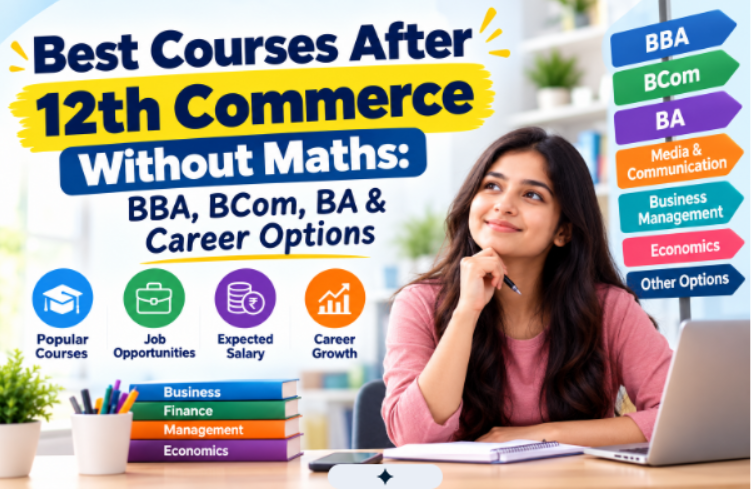
Choosing a course after Class 12 Commerce without Maths doesn’t limit your career options. You can opt for a Bachelor of Business Administration (BBA), Bachelor of Commerce (BCom), Bachelor of Arts (BA), or professional courses like Chartered Accountancy (CA) and Company Secretary (CS). These careers provide routes into business management, marketing, accounting, corporate law, and human resources, to name a few. If you are searching for the best courses after 12th commerce without maths, you are in the right place. Read on to know more.
Why Choose Commerce Without Maths After 12th
Commerce without Maths opens many career paths in business, management, finance, and corporate law. Students can opt for degrees like BBA, BCom, BA, or professional qualifications like CA, CMA, and CS as per interest and eligibility. The trick is to find a course that develops relevant skills and offers you career prospects that line up with your long-term goals.
High-Paying Career Alternatives
| Career Option | What the Role Involves | Salary Range |
| Marketing Executive | Coordinating promotional campaigns, researching customers, and supporting brand activities. | ₹3.0–6.06 LPA |
| HR Executive | Coordinating recruitment, maintaining employee records, and supporting onboarding. | ₹3.0–6.0 LPA |
| Business Development Executive | Identifying potential clients, generating leads, and supporting sales growth. | ₹3.0–5.0 LPA |
| Public Relations Executive | Drafting communications, coordinating media activities, and managing brand reputation. | ₹2.5–4.5 LPA |
| Compliance Executive | Maintaining compliance records, tracking documentation, and supporting regulatory requirements. | ₹2.5–4.5 LPA |
| Digital Marketing Executive | Supporting SEO, social media campaigns, online advertising, and campaign reporting. | ₹2.5–4.0 LPA |
Top High-Demand Degrees After 12th Commerce (No Math Required)
Your path will depend on your interests, eligibility, and long-term career goals. Below are some high-demand degrees you can pursue after class 12th commerce without maths.
1. Bachelor of Business Administration (BBA)
A BBA course is an undergraduate degree program that introduces students to the basic functions of a business organisation such as marketing, human resource management, financial management, accounting, operations, and entrepreneurship. Most courses take three or four years, depending on the university and the course structure.
2. Bachelor of Commerce (BCom General)
BCom includes accounting, business law, economics, taxation, and commercial practices. The degree can be useful for banking, accounting, insurance, and financial operations. Check the subject and entry requirements before applying.
3. Bachelor of Arts (BA) & Professional Humanities Courses
Students interested in communication, society, research, or creative work may be interested in a BA in English, psychology, political science, sociology, journalism, or public administration. Career options include: content writing, journalism, and public relations management.
Professional Certification Courses After 12th Commerce
Students interested in accounting, finance, or corporate compliance can pursue professional qualifications after Class 12.
Chartered Accountancy (CA)
The Institute of Chartered Accountants of India (ICAI) offers the Chartered Accountancy (CA) qualification and trains students for careers in accounting, auditing, taxation, and financial management. Students can take up the CA Foundation route post Class 12, which includes Accounting, Business Laws, Quantitative Aptitude and Business Economics.
Cost and Management Accountant (CMA)
The Cost and Management Accountant (CMA) qualification offered by the Institute of Cost Accountants of India (ICMAI) covers cost accounting, budgeting, financial planning, and cost control. The qualification prepares students for roles in cost management, financial analysis, budgeting, and corporate finance.
Company Secretary (CS)
CS is suitable for students who are interested in company law, corporate governance, and compliance. It includes business communication, fundamentals of accounting, economic and business environment, business laws, and management. Mathematics is not a compulsory requirement. Graduates can pursue careers in corporate compliance, legal administration, and governance.
Best Career & Jobs with High Salary
Commerce students can work in different industries, but the right role depends on your qualification, your ability to communicate, practical experience, and specialisation you have chosen.
Corporate Management & Marketing Roles
A BBA, BMS, BCA course, or related business degree can prepare students for entry-level roles such as:
- Marketing Executive: Assists in the promotional activities of marketing campaigns, performs initial market research, and evaluates the effectiveness of the marketing campaign.
- Sales Associate: Provides information regarding products or services, assists in responding to sales enquiries.
- Human Resources Manager: Evaluates applications, sets up interviews, and handles communications with applicants.
- Business Development Executive: Identifies prospects, generates sales leads, and maintains contact with the prospects.
Note: BCA is not necessarily available to students without Maths, as eligibility varies by university.
Banking, Insurance & Financial Services (non-Math)
Commerce graduates need not specialise in maths. They can opt to join entry-level jobs in banks, insurance companies, and financial services firms. Popular options are:
- Sales Associate: Advises customers regarding product/services; answers questions regarding the sale.
- HR Manager: Oversees the recruitment process, from screening applications and interviewing candidates to issuing offer letters.
- Business Development Executive: Identifies potential customers, develops sales leads, and maintains harmonious relations with potential customers.
How to Choose the Right Course for You?
Decide based on your interests, eligibility, and career aspirations. Consider the following points while deciding:
- Know your interests: Choose a course based on your interests, skills, and aptitude. If you are interested in Business Management, Accounting, Communication, Humanities, etc., then choose accordingly.
- Eligibility: Look out for the minimum percentage, required subjects, and entrance exams for the course you want to pursue at your desired college.
- Curriculum: Check out the subjects covered and how much quantitative work will be involved in the curriculum.
- Cost and Duration: Find out about the fees, extra costs, and duration of the course.
- Career opportunities: Research what kind of opportunities the course will provide. Are there good opportunities for internships, industry, and placements? Will you be able to do higher studies? This will help you decide whether this course will help you in the future.
Emerging Job Markets and Industries
For commerce students without a maths background, there are emerging industries to explore that will blend business expertise with communication and digital skills. Some of the related career options include:
- Digital Marketing: SEO Executive, Social Media Executive, social media account management, performance analysis of the campaign.
- E-commerce: E-commerce executives are hired by e-sellers to manage product listings, check orders, and manage returns of goods and services.
- Content Strategy: Content writer, topic research, content calendar management.
- Customer Support: CRM Executive, solving customers’ queries, record-keeping.
Conclusion
The type of course you should pursue after 12th Commerce (without maths) depends on your interest, eligibility, and future goals. Look at the different courses offered by the institutions and compare the curriculum, fees, eligibility, and future prospects. To increase your chances of getting a job, gain hands-on experience by doing internships, projects, and gaining relevant certifications. With the right course and a clear career plan, you can build a rewarding career without having studied Mathematics in Class 12.