
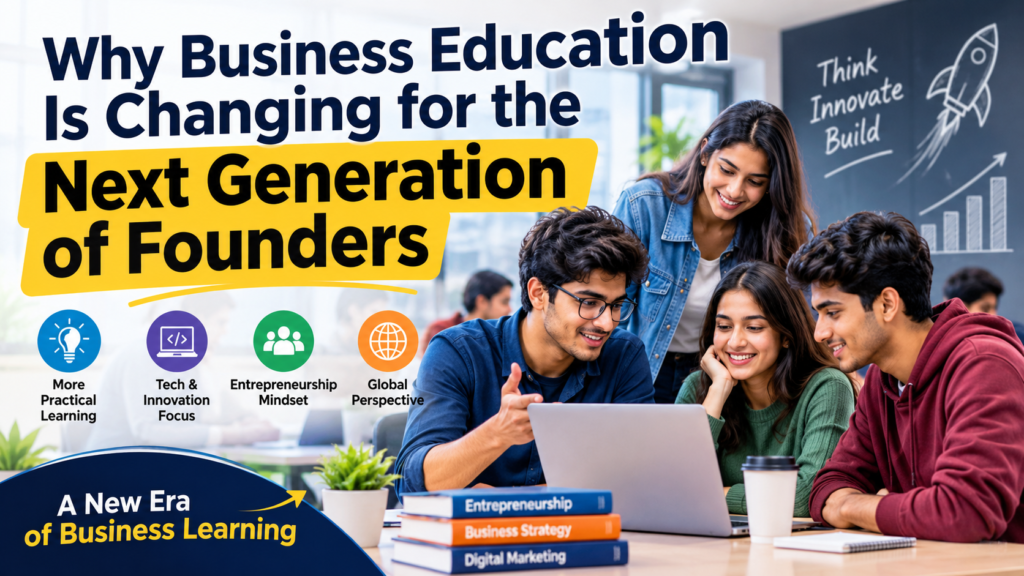
The way businesses are built is changing, and so is the kind of education future founders need. A founder today is expected to understand customers, make decisions with incomplete information, use technology intelligently, manage money, build teams, and adapt quickly when an idea does not work as planned.
That is why business education is gradually moving beyond classroom knowledge alone. Concepts such as finance, marketing, strategy, and operations still matter, but students increasingly need opportunities to apply them in uncertain, real-world situations.
From Learning Concepts to Testing Them
Traditional business education has often focused on understanding established frameworks and management principles. For future founders, however, knowing a concept is only the beginning. They also need to test whether it works in the market.
This is where simulations, live projects, market research, business challenges, internships, and venture-building activities become valuable. Instead of only learning what a business model is, students can explore whether customers actually need the solution, whether they are willing to pay for it, and whether the model can work outside the classroom.
Entrepreneurship Is Becoming a Practical Capability
Entrepreneurship is no longer relevant only to people who already have a startup idea. The ability to identify opportunities, question assumptions, solve problems, and act under uncertainty is useful across industries.
A student may eventually become a founder, join a startup, enter a family business, or work inside a larger organisation. In each case, entrepreneurial thinking can help them respond to change rather than wait for a fixed set of instructions.
This shift is one reason an MBA entrepreneurship pathway is increasingly attractive to students who want business education to include venture building, market validation, decision-making, and practical exposure alongside core management learning.
Technology Is Changing the Founder’s Toolkit
The tools available to founders have expanded dramatically. AI can help analyse information, digital platforms can reach customers across geographies, cloud software can support operations, and social media can help a new brand build an audience quickly.
But access to technology does not automatically create a successful company. Founders still need to decide what problem is worth solving, which customers to focus on, what data to trust, and whether a particular tool genuinely improves the business.
Business education therefore has to teach more than how technology works. It needs to help students understand when, where, and why to use it.
Learning Through Experimentation
Building a business rarely follows a perfectly predictable path. A product may not receive the expected response. Customers may reject the original price. A marketing idea may fail. A founder may discover that the actual problem is different from the one first assumed.
These situations make experimentation essential.
Modern business education can give students room to build prototypes, test ideas, receive feedback, revise assumptions, and try again. The value of this process is not in avoiding every mistake. It is in learning how to recognise what went wrong, interpret evidence, and make a better decision the next time.
Mentorship and Networks Matter More Than Ever
Founders rarely build alone. They learn from customers, mentors, investors, peers, industry professionals, and other entrepreneurs.
This is why business schools are increasingly becoming ecosystems rather than only academic institutions. The right mentor can challenge an assumption. A founder interaction can reveal an operational problem that no textbook explains. A peer may become a future collaborator or co-founder.
At EIMR Business School, this shift is reflected through an approach that combines academic learning with business challenges, industry interaction, mentorship, networking, and opportunities to work on real business ideas. The objective is to help students understand how concepts move from discussion to execution.
Preparing Founders for What Cannot Be Predicted
The next generation of founders will build in an environment shaped by AI, changing customer behaviour, global competition, new business models, and rapidly evolving technology. No curriculum can predict every challenge they will face.
That is precisely why business education is changing.
Its role is no longer limited to explaining how successful businesses operate. It also needs to help students develop judgement, adaptability, financial awareness, communication skills, and the confidence to act when there is no ready-made answer.
For future founders, the most valuable education may not be the one that gives them every answer. It may be the one that teaches them how to keep building when the answer is not obvious.