
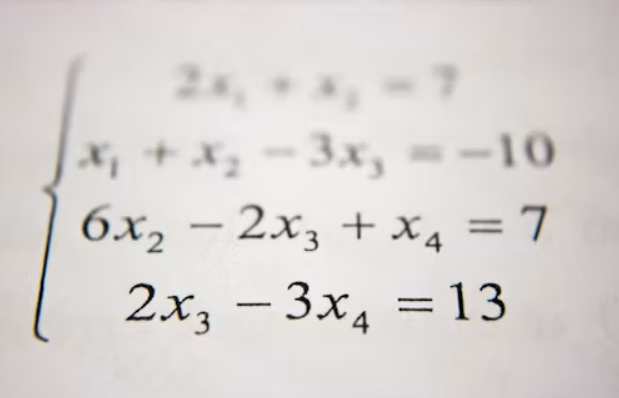
Not everyone is a natural when it comes to mathematics. Although basic numeracy should be within the grasp of most students, more advanced topics can lead to frustration. If these go unchecked and sufficient progress isn’t made, then it can knock some students’ confidence, leading them to think they’re no good at the subject. Trying online tutorials, asking a fellow student for their input or seeking professional help can boost self-confidence. The kind of math teacher in Kolkata and other big Indian cities that are available nowadays can be a huge help for students who are struggling and need to regain some morale.
In the meantime, read on to find out why some students seem to find mathematics easier than others and what you can do about it if you think you’re not making the progress you would like.
Why Do Some Students Find Maths Difficult?
One of the main reasons some students find they’re not keeping up with maths is that they have gaps in their knowledge. If you missed a lesson or two when you were younger, you may not be able to grasp concepts as easily as your fellow students seem to. Maths studies tend to become increasingly complex as you learn more. This alone can create issues for some students, so you need a solid foundation.
Even with one, problem-solving with unfamiliar wording or framing can make quite straightforward mathematical assignments seem tougher than they really are. Lastly, some students suffer because the lesson programme moves on before they’re ready, usually before they’ve given sufficient practice to embed what they have just been taught. The good news is that all of these issues are surmountable.
How Strong Foundations Make More Advanced Maths Easier
As mentioned, strong foundations form the bedrock of all mathematical studies. Going back to basics and relearning simple concepts can be a big help. It isn’t about heading in the wrong direction, but rather about taking remedial action to fill in the gaps in your knowledge.
Remember that mathematics is often inter-disciplinary. Understanding how graphs and charts work, for example, might not be needed for higher-level maths problems but if the information you need to take on board to assess what the problem is has been given to you in such a format, then you’ll need that knowledge. Equally, geometric problem solving may rely on a sound foundation in algebra, while solving a probability problem might mean being able to perform basic statistical analysis.
In short, never be afraid to take a step back to underpin your mathematical knowledge.
Practical Ways to Build Maths Skills and Confidence
One of the simplest steps you can take to improve your confidence with maths is to check your answers to the assignments you have been set. When you see an answer you have given which is incorrect – or only partially correct – you should reread the question and make sure you understood it. Follow your working out to discover where the error occurred.
Often, this can be from a sloppy mistake, indicating you understood what to do but failed to execute. If you still can’t see how or why you went wrong, then it is likely to be the result of a gap in your knowledge for which you should seek help. Overall, breaking maths problems down into the constituent parts will help. Try not to jump too many stages in your head in one go. Write your working out down, so you can assess it later. Lastly, keep practising, not only with old papers and textbook assignments but by applying maths to real-world situations in your daily life, as well.