
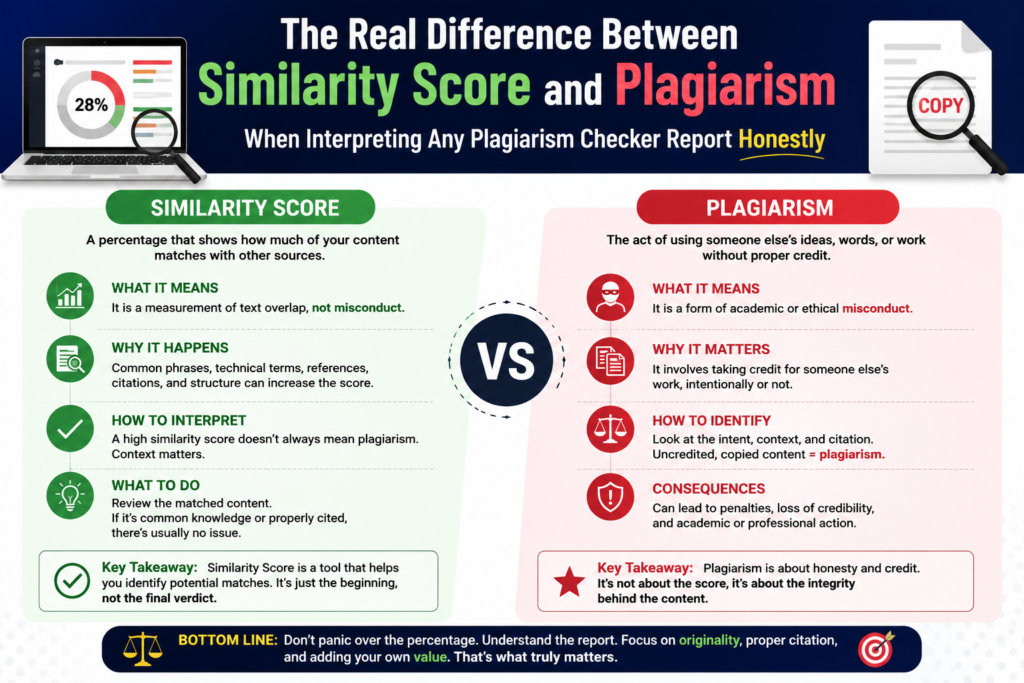
A plagiarism checker report opens with a number. Twelve percent similarity. Forty seven percent. Eighty three percent. That number is what most users of these tools react to first, and it is also the most commonly misread piece of information in the entire report. High similarity does not automatically mean plagiarism. Low similarity does not automatically mean originality. The relationship between the two is much less direct than the reporting style suggests.
For writers and editors who use plagiarism checkers as part of their editorial workflow, learning to read the similarity score for what it actually says, rather than what it appears to say, is one of the higher-value adjustments to how these tools produce useful information.
This guide walks through what similarity score actually measures, why it is not equivalent to plagiarism, and how six specific score patterns should be interpreted differently from how they usually get interpreted at first glance.
What the Similarity Score Actually Measures
A similarity score is a percentage representing how much of the submitted text overlaps, at the word or phrase level, with sources the checker has access to. If ten percent of the submitted text matches sources in the database, the report shows ten percent similarity. That is the entire computation. There is no judgment about intent, attribution, permission, or contextual significance built into that number.
This matters because plagiarism is a judgment about the nature and intent of the overlap, not just its presence. A quoted passage with full citation contributes to the similarity score in exactly the same way as an uncited copy of the same passage. A properly attributed reference to a definition looks identical to an unattributed paste of that definition. The tool cannot distinguish between the two, because the two look the same at the level of text matching.
Plagiarism, by contrast, requires taking someone else’s work and presenting it as your own without appropriate attribution. Similarity is a purely quantitative measurement. Plagiarism is a categorical judgment. The two are related but not equivalent.
Why High Similarity Does Not Always Mean Plagiarism
A high similarity score can come from perfectly legitimate sources of text overlap. Direct quotations with proper citation. Commonly used phrases and technical terminology. Recycled boilerplate language from the writer’s own previous work. References and citations that appear in identical form across many sources. Standard disclaimers and legal language.
All of these produce similarity without producing plagiarism. A checker that reports fifty percent similarity on a research literature review may be flagging a report that is entirely properly cited, because that specific genre of writing legitimately overlaps heavily with source material through the quotations and references it is expected to contain.
Why Low Similarity Does Not Always Mean Originality
The opposite misinterpretation is equally common. A low similarity score can hide substantial intellectual borrowing that never rises to the level of verbatim overlap. Heavy paraphrasing that preserves argument structure but changes surface wording. Ideas taken from a source without proper credit. Direct translations from sources in other languages. Structural copying where the writer follows another piece’s argument, sequence, and evidence choices while writing the words themselves.
None of these register as similarity in a text-matching report, and all of them can constitute plagiarism depending on context. A low score, treated as a definitive originality verdict, misses this entire category of concern.
The Six Similarity Score Patterns
Score patterns tend to fall into recognizable shapes, and each shape carries different implications for how the report should be read. Six specific patterns show up consistently across genres and contexts.
The Score Interpretation Reference
The six patterns, what each looks like in a typical report, how they tend to get interpreted at first glance, what they actually mean once examined properly, and what the correct editorial response is are mapped below.
| Score Pattern | Common Interpretation | Actual Meaning | Correct Response |
| Very high, one source | Serious plagiarism | Direct copying from one source, verify attribution | Check whether source is properly cited |
| Very high, many sources | Serious plagiarism | Often heavy quotation or common language use | Examine which specific passages triggered matches |
| Moderate, one source | Partial copying | Extended reliance on one source, review context | Read matched passages for attribution quality |
| Moderate, many sources | Some copying present | Distributed common language, usually benign | Skim matched segments briefly, likely acceptable |
| Low but concentrated | Almost original | Small amount of direct copying in specific passages | Investigate concentrated matches carefully |
| Low and scattered | Fully original | Text-level originality, does not verify idea originality | Accept the text-level signal, apply editorial judgment |
The pattern across all six is that the score alone rarely tells the reviewer what to do. What matters more is where the matches are concentrated, how they relate to each other, and whether the surrounding context suggests legitimate quotation or unattributed copying. A reviewer who reads the report properly spends less time on the aggregate percentage and more time on the segment-level detail underneath it.
How Score Patterns Should Change Editorial Decisions
The practical consequence of understanding the score-versus-plagiarism distinction is that the same numerical score should produce different editorial responses depending on what the pattern looks like underneath.
A twelve percent score concentrated in one source with no citation is a different problem from twelve percent scattered across dozens of common phrase matches. A fifty percent score on a research literature review with heavy quotation is a different situation from fifty percent on an original argument piece. Same score, different reality, different response.
Editorial workflows that treat the aggregate score as the report’s main information miss most of what the report is actually saying. Workflows that treat the segment-level detail as the main information get closer to what the tool is genuinely useful for.
Where Phrasly’s Plagiarism Checker Fits
For writers and editors who want a report that supports segment-level interpretation rather than aggregate-score-only reading, the plagiarism scanning tool inside Phrasly’s workspace produces both an aggregate similarity percentage and detailed source-attribution output showing which specific passages matched which sources. That detail turns the report into something a reviewer can actually make decisions from.
Used with an understanding that the aggregate score is the summary rather than the substance, the report becomes a diagnostic tool for finding the passages that actually need review, rather than a black-box verdict on the piece as a whole.
The Broader Workspace Context
Beyond plagiarism checking specifically, Phrasly AI operates a workspace that bundles plagiarism checking, AI detection, writing enhancement, and several writing utilities in one place. Plagiarism scanning and AI detection remain separate scans producing separate reports, since the two tools measure fundamentally different properties of writing.
What Score Analysis Cannot Substitute For
Even a carefully interpreted similarity score cannot substitute for the editorial judgment about whether the writing represents genuine intellectual contribution. A properly cited report with fifty percent quotation may be excellent work. A report with two percent similarity may still involve substantial idea theft that leaves no text-level trace. The score reports on text overlap. It does not report on originality of thought.
Score analysis is a starting point for editorial review, not a replacement for it. What the score tells the reviewer is where to look. What the reviewer decides after looking is where the actual editorial judgment happens.
The Score-vs-Plagiarism Distinction
For writers and editors using plagiarism checkers in their editorial workflow, the score-versus-plagiarism distinction is a property of the tool worth internalizing. The similarity score reports on text overlap. Plagiarism is a categorical judgment about attribution, intent, and context that requires human interpretation of what the score is actually showing.
Reading the report through this distinction produces more accurate editorial decisions. High scores prompt investigation of what specific overlap is present, not immediate assumptions about dishonesty. Low scores confirm text-level originality, not intellectual originality more broadly. Neither number substitutes for the reviewer’s attention to how the specific matches sit in the context of the specific piece being reviewed.
The score summarises what the tool measured. The reviewer interprets what that measurement means for the specific writing in front of them. Both layers are necessary, and both depend on understanding that the number and the judgment are related but not equivalent.