
Electric charges can exert forces on each other. When two particles have the same type of charge, they repel each other. Coulomb’s Law helps us calculate the force between charged particles and determine the amount of charge they carry.
In this question, two negatively charged dust particles repel each other. Using the distance between them and the force of repulsion, we can calculate the number of electrons present on each particle.
The Distance Between Two Negatively Charged Dust Particles Is 1mm: Question
Question: The distance between two negatively charged dust particles is 1 mm, and they repel each other with a force of (4.0 \times 10^{-5}) N. If the charge on one particle is 4 times that of the other, find the number of electrons charging them separately. The charge on an electron is (\left(\frac{5}{3}\right)\times10^{-19}) C.
Options
| Option | Number of electrons on the two particles |
|---|---|
| A | (2\times10^8) and (8\times10^8) |
| B | (4\times10^8) and (8\times10^8) |
| C | (2\times10^9) and (4\times10^9) |
| D | (8\times10^7) and (2\times10^8) |
Correct Answer
Option A: (2\times10^8) and (8\times10^8) electrons.
The particle with the smaller charge has (2\times10^8) excess electrons, while the particle with the larger charge has (8\times10^8) excess electrons.
Explanation: Coulomb’s Law
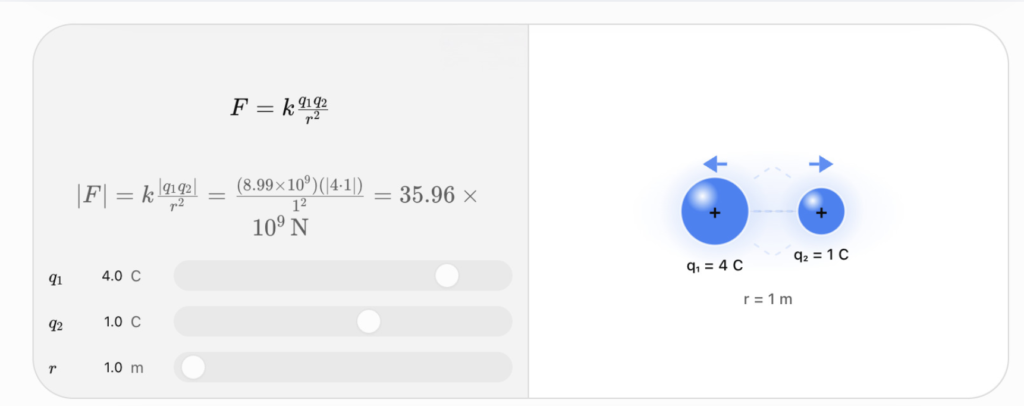
Coulomb’s Law describes the electrostatic force between two stationary point charges. The force depends on the magnitude of the charges and the distance between them.
Step 1: Write the Given Values
- Distance between particles: (r=1\text{ mm}=10^{-3}\text{ m})
- Force of repulsion: (F=4.0\times10^{-5}\text{ N})
- Charge ratio: (q_1=4q_2)
- Charge of one electron: (e=\left(\frac{5}{3}\right)\times10^{-19}\text{ C})
- Coulomb’s constant: (k=9\times10^9\text{ N m}^2/\text{C}^2)
Let the smaller charge be (q). The larger charge will then be (4q).
Step 2: Apply Coulomb’s Law
Using the magnitudes of the charges:
[
F=k\frac{|q_1q_2|}{r^2}
]
Substitute (q_1=4q) and (q_2=q):
[
F=k\frac{4q^2}{r^2}
]
Rearranging to find (q):
[
q=\sqrt{\frac{Fr^2}{4k}}
]
Step 3: Calculate the Smaller Charge
Substitute the given values:
[
q=\sqrt{\frac{(4.0\times10^{-5})(10^{-3})^2}
{4(9\times10^9)}}
]
[
q=\sqrt{\frac{4.0\times10^{-11}}{3.6\times10^{10}}}
]
[
q=\sqrt{1.111\times10^{-21}}
]
Therefore,
[
q=3.333\times10^{-11}\text{ C}
]
The smaller particle has a charge magnitude of approximately (3.333\times10^{-11}) C.
Step 4: Find the Number of Electrons on the Smaller Particle
The number of excess electrons is calculated by dividing the charge magnitude by the charge of one electron.
[
n=\frac{q}{e}
]
[
n=\frac{3.333\times10^{-11}}
{(5/3)\times10^{-19}}
]
[
\boxed{n=2\times10^8\text{ electrons}}
]
Step 5: Find the Number of Electrons on the Larger Particle
The charge on the second particle is four times the smaller charge:
[
q_1=4q
]
Since the number of electrons is directly proportional to the charge magnitude, the larger particle contains four times as many excess electrons.
[
n_1=4\times2\times10^8
]
[
\boxed{n_1=8\times10^8\text{ electrons}}
]
Final Answer
The number of excess electrons on the two negatively charged dust particles is:
- Smaller charge: (2\times10^8) electrons
- Larger charge: (8\times10^8) electrons
Therefore, the correct answer is Option A: (2\times10^8) and (8\times10^8) electrons.
Read More Also – Which One of the Following Is a Weak Acid?